Headway is one of the most downloaded book summary apps in the world. The pitch: listen to or read 15-minute summaries of popular nonfiction books, mostly self-help. Learn while you commute. Replace doomscrolling with microlearning. Become a better version of yourself.
I spent some time inside the app, and to me, Headway is a self-soothing ritual pretending to be an education product.
It’s more like a meditation app
The user’s actual problem is anxiety: “I’m not reading enough, I’m wasting my time, I’m not growing”. The product offers a ritualized consumption activity that feels like addressing the problem. Progress is measured in streaks and units consumed, not outcomes achieved. And the effectiveness is debatable. How much does reading the summary of “I Will Teach You to Be Rich” move you closer to your goal?
And what exactly is your goal? Do people who use this app think about that before tapping “Play” on a summary?
But don’t worry. Headway is offering you a daily routine, and every time you do that, you will feel better.
The content doesn’t matter (and the app knows it)
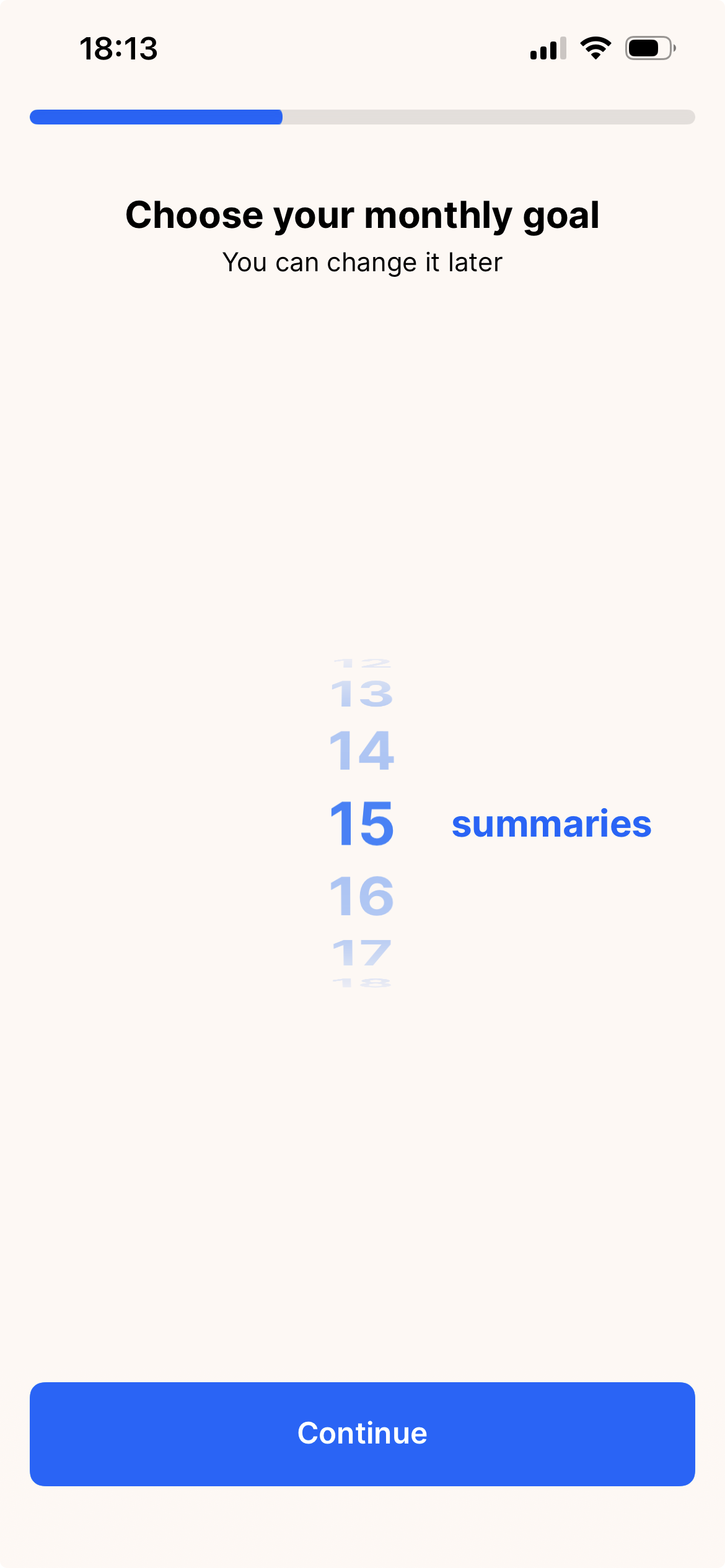
During onboarding, the app asks you to choose a monthly goal, measured in summaries consumed. 15 is the default. Would you be able to understand 15 summaries in a month, let alone actually apply them to your life? Of course not. But the right question is: does choosing “15 summaries” make you feel like you’ve committed to something? Yes. And that’s the product working.
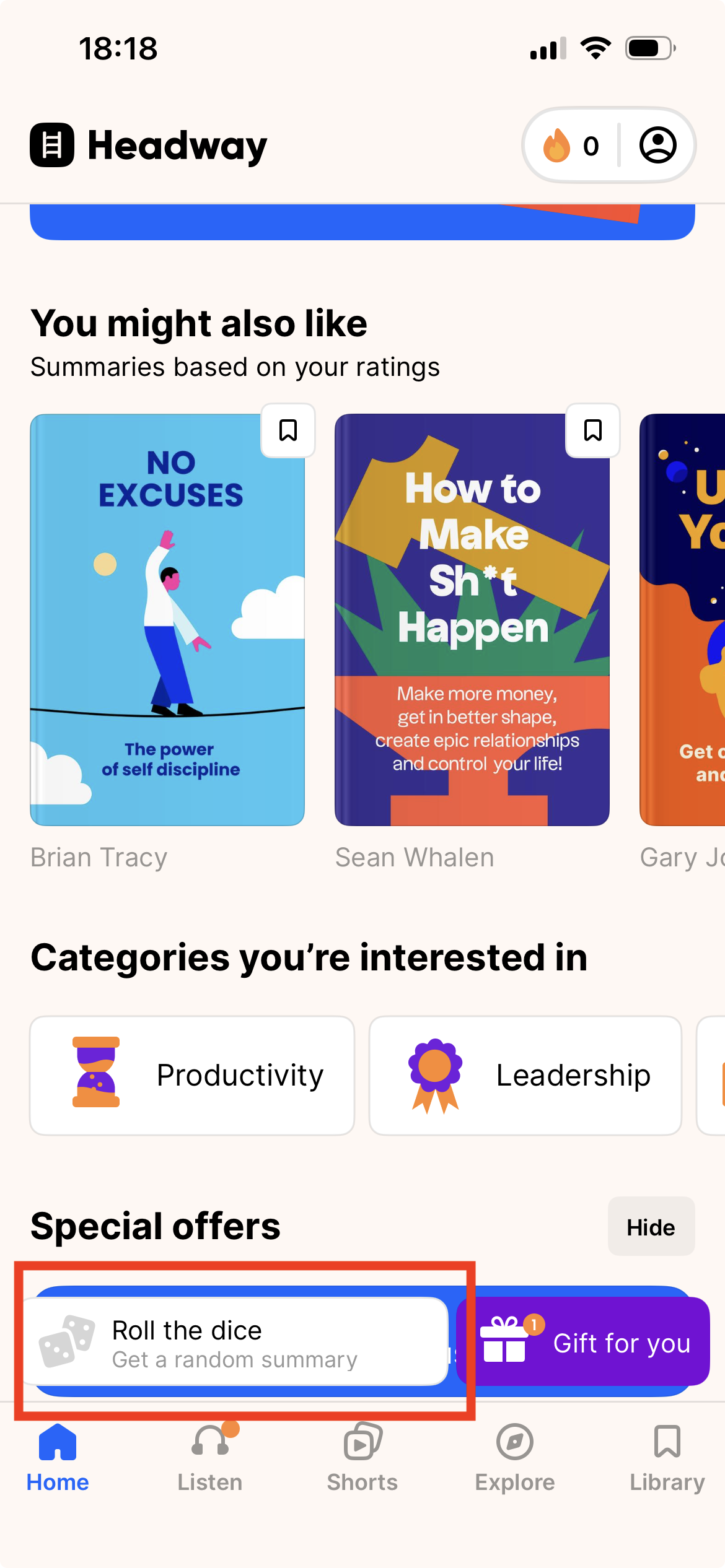
The app has a “Roll the dice” feature, which lets you tap it to get a random summary. For a self-help app, it’s not unreasonable to expect it to help users gain clarity, helping them know what they need to do. Or at least, not distract the users away from “not knowing”. But instead, the product says out loud: it doesn’t matter which book you read next. The content is interchangeable. You’re not here to solve a specific problem, to keep moving with a concrete plan you came up with yourself. You’re here to consume a unit of self-improvement-shaped content. It’s not different from YouTube’s Autoplay, but you won’t feel guilty about it.
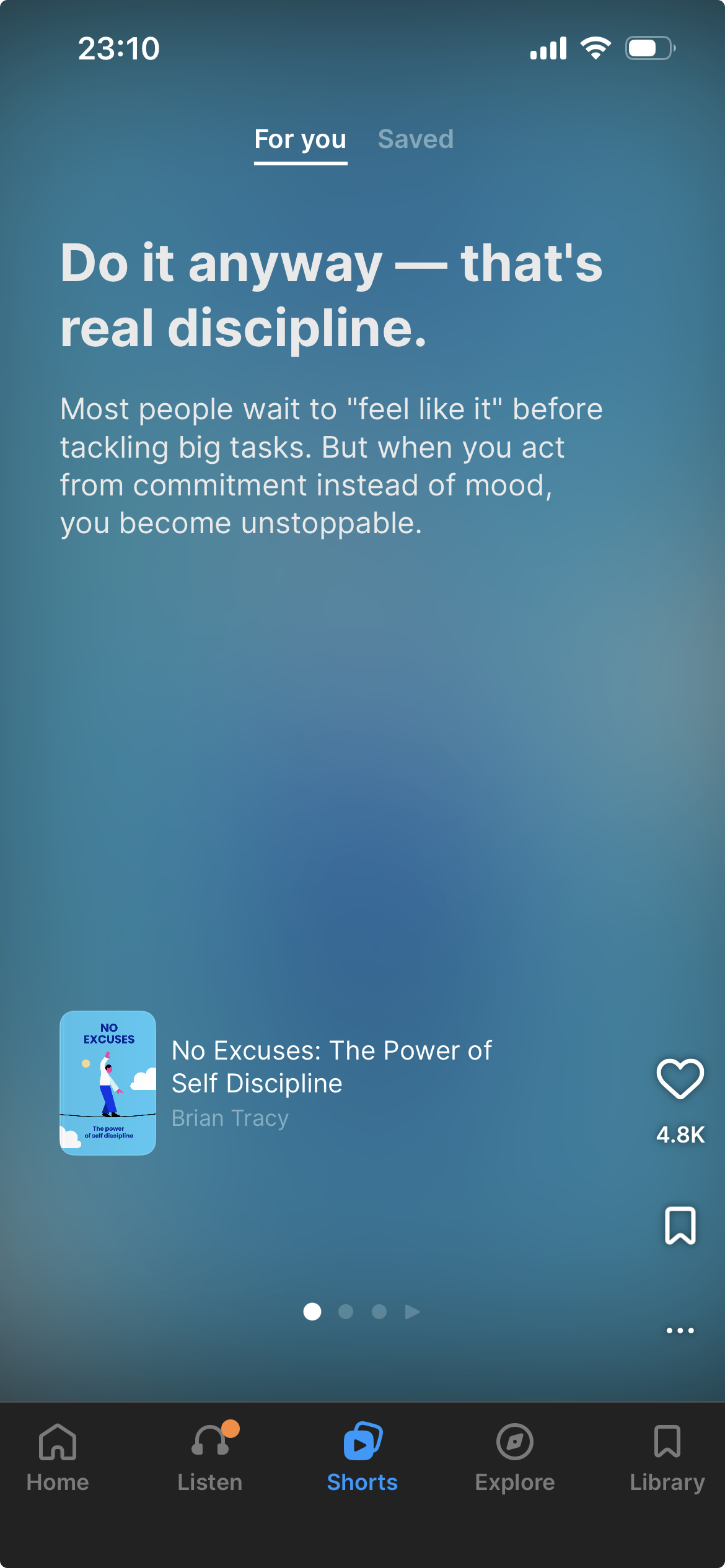
There are also Shorts - swipeable snippets like a TikTok feed. One I saw: “Do it anyway — that’s real discipline”. I mean… yeah? Nothing new here, but users feel good reading it. The goal is to keep consuming. Maybe the user will save the snippet to their Library, feeling like they’re collecting wisdom. But how many items in a person’s bookmarks or reading list they haven’t read? The app creates a condition for users to do something that feels productive but not really so.
Additionally, there’s a problem with summarization: it’s interpretation.
Someone at Headway decided what’s important in each book and what isn’t. That person doesn’t know your context. They don’t know what you’re struggling with, what you’ve already tried, what would actually be relevant to your situation. You’re outsourcing an important part of reading (deciding what matters to you) to a stranger optimizing for broad appeal.
And then it gets uncomfortable with how the app does monetization
The onboarding flow is carefully designed. You answer several questions about your goals, your problems and interests. By the time the free trial popup appears, you’ve invested effort and made some kind of commitments. Do you want to waste all the previous steps customizing the app? And it’s just a free trial by the way.
Headway has received complaints about: users not being able to cancel the subscription (contacted support but no response), not knowing they would be charged (no notification), or deceptive designs. (sources: 1, 2, 3 - click “See all reviews” at the bottom).
You can only read one summary the app gives you. If you were confident in your product’s quality, you’d let people sample a few. Maybe otherwise, the user will realize this is just a blog post about Atomic Habits that they can get anywhere?
Every two taps is a popup asking you to subscribe. I navigated from Shorts to Home and immediately got a modal: a cute cartoon brain mascot holding a gift box.
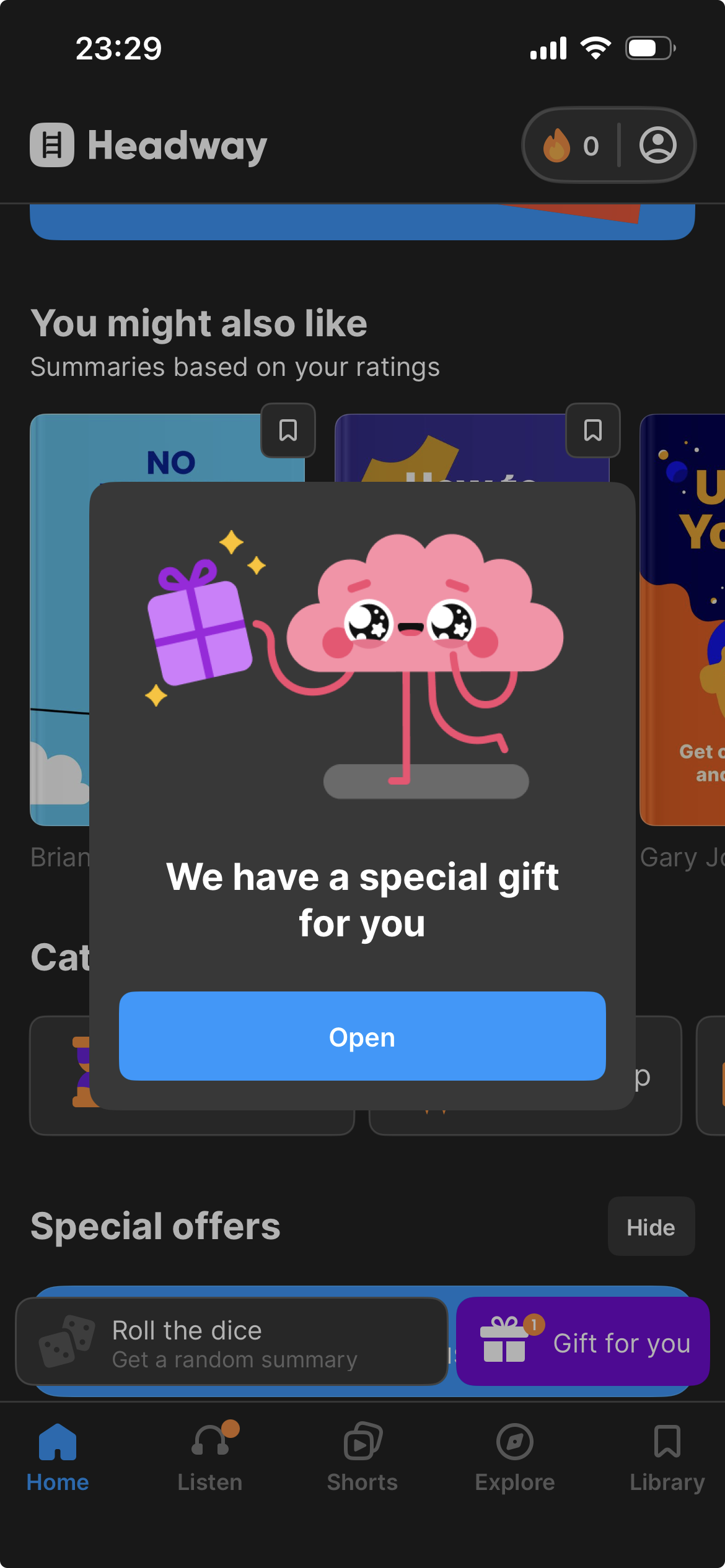
The “gift” is the privilege of paying them monthly. The entire UX vocabulary is warmth, care, and growth - while the mechanism underneath is a subscription paywall on every surface.
I wondered if the aggressive monetization was necessary. Maybe they’re paying publishers for the right to summarize and monetize their books, like CliffsNotes or getAbstract do? But no. Headway’s FAQ states plainly:
“We want to summaries constitute bundles of key book’s ideas and insights. The summaries themselves are original works that consist of books’ ideas. We use book titles to explain to users the ideas from which specific books our summaries represent. This effectively means that we use book titles to refer to the books as those of the authors. Such use is justified by the fact that without mentioning a specific book title it is impossible to identify a summary.”
I’m curious why they operate differently than other services. But that’s a different topic.
Anyway, their aggressive monetization is not about funding content costs (the content is cheap to produce, especially with the help of AI). It’s just about margin.
What problems does this app actually solve?
Headway addresses the scrolling itch. You’re going to be on your phone anyway. Swiping through Headway is a little better than swiping Reels. Though arguably, you can do the same by curating your social media feed (and Instagram and TikTok could even be better because you have a community in the comment section).
It reduces the time cost of bad books. Most self-help books could be condensed to be 10% of their length. If you’re the kind of reader who would otherwise spend 8 hours uncritically absorbing a padded bestseller, spending 15 minutes on the summary is objectively better time management.
It eases the anxiety of inaction. “I read 3 summaries today” quiets the inner voice that says “you’re wasting your life”. Whether that’s genuine progress or just a sedative is a question the app has no incentive to help you answer.
It also solves the anxiety of uncertainty. The app gives you a map - predefined growth paths across topics like “Leadership” or “Love & Sex”. For users who feel overwhelmed by not knowing where to start, or are afraid that the path they devised for themselves might not work, having someone say “here’s the path” is comforting.
The takeaway
This is the world we live in now 😔 The feeling of being productive beats the real thing in the market, because it’s frictionless and comforting. And you can’t fail at reading a 15-minute summary, the same way you can’t fail at setting up a Notion personal dashboard, or an Obsidian “second brain” notetaking system.
Headway’s just making what people want.